Research
About the research project
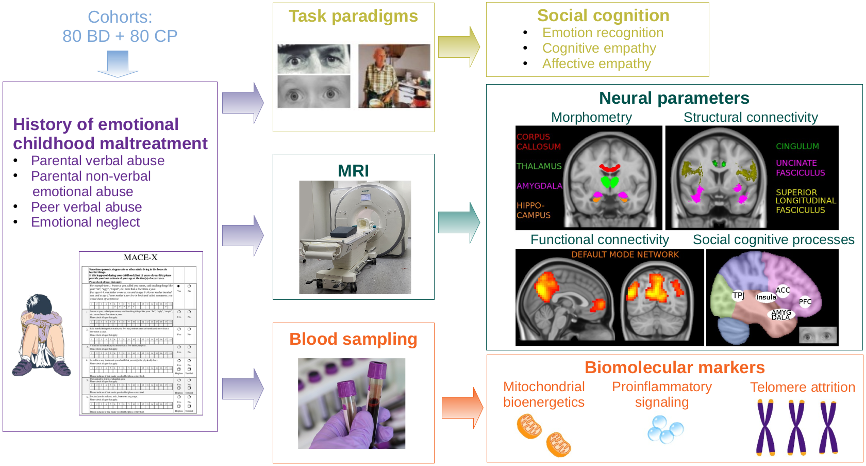
This FWF funded research project Life-events (entitled “Socio-cognitive and biological responses to maltreatment”) aims to investigate how a history of positive and negative childhood experiences are associated with different aspects of psychological (social behaviour, empathy) and biological (brain function and structure, immune function and inflammation) health in bipolar disorder (BD) compared to healthy control participants (CP). This multidisciplinary study will assess the association between a history of childhood maltreatment (CM) and psychological well-being at two points in time at the Department of Psychiatry, Psychotherapy, Psychosomatics and Medical Psychology at the Medical University of Innsbruck (MUI). Additionally, we want to understand how emotional CM affects brain function and structure and biomolecular distress markers (telomere length in immune cells together with inflammatory signaling). To this end, we will perform and analyse magnetic resonance imaging (MRI) in collaboration with the Neuroimaging Core Facility (MUI) and collect blood samples in collaboration with the Department of Psychology (Leopold-Franzens University of Innsbruck). Finally, we will look at a combination of the psychological and biological tests to see if there is a link between emotional CM and health outcomes. The results should help to provide more personalised therapy (i.e. trauma, emotional or empathy-focused treatments) and medicine to improve outcomes.
Teilnehmer:innen gesucht!
Die Medizinische Universität Innsbruck und die Leopold-Franzens-Universität Innsbruck suchen Personen, die sich für die Teilnahme an einer wissenschaftlichen Studie interessieren. Diese untersucht, inwiefern sich verschiedene Kindheitserfahrungen auf das Stressempfinden und die Fähigkeit, sich in andere hineinzuversetzen (Empathie), auswirken.
WAS PASSIERT IN DER STUDIE?
Zunächst wird Ihnen der Studienarzt in einem Gespräch die Studie genau erklären und prüfen, ob alle Einschlusskriterien erfüllt sind. Falls Sie einverstanden sind teilzunehmen, bitten wir Sie, einige Fragebögen auszufüllen. Anschließend erfolgt nach einer kurzen neuropsychologischen Untersuchung die Durchführung einer Magnetresonanztomographie (MRT) des Gehirns. Abschließend nehmen wir eine Blutprobe ab, um aus dieser bestimmte Marker für Stress zu messen. Insgesamt sind zwei Termine im Abstand von zwölf Wochen vorgesehen, die Dauer eines Termins beträgt zwei Stunden.
WELCHE VORAUSSETZUNGEN MUSS ICH FÜR DIE TEILNAHME ERFÜLLEN?
•Alter zwischen 18 und 65 Jahren
•Keine bestehende Diagnose einer psychischen Erkrankung
•Keine Schwangerschaft, kein Stillen
•Fließende Deutschkenntnisse
•Keine Metall-Implantate (als MRT Kontraindikation)
•Keine bekannte Blutgerinnungsstörung
WELCHE VORTEILE BRINGT DIE TEILNAHME?
•Aufwandsentschädigung von 20€ pro Stunde (Gutscheine)
•Kostenlose medizinische Untersuchung (MRT)
•Information über Studienergebnisse
•Wichtiger Beitrag für Forschung und medizinische Behandlung
HABEN WIR IHR INTERESSE GEWECKT?
Dann melden Sie sich bitte bei:
Studienleiterin: Dr. Noora Tuovinen, Medizinische Universität Innsbruck
Tel: 0512-504-83819, Email: life-events@i-med.ac.at
Social cognition
This study aims to investigate the association of self-reported history of emotional childhood maltreatment with social cognition (i.e. emotion recognition, cognitive and affective empathy) in control participants and in individuals diagnosed with bipolar disorder, both with and without a history of childhood maltreatment.
Neural (magnetic resonance imaging) parameters
This study aims is to characterize the association of history of emotional childhood maltreatment with neural (i.e. morphometry, task-based functional magnetic resonance imaging [MRI] responses, functional connectivity, white matter) MRI parameters.
Biomolecular (blood-based) markers
This study aims is to characterize the association of history of emotional childhood maltreatment with biomolecular markers (i.e. telomere length, mitochondrial bioenergetics and biogenesis) in peripheral blood mononuclear cells (PBMC) and blood plasma (selected immune-response mediators for inflammatory profiling).
Funding
This research is funded by the Austrian Science fund (FWF) under grant number 10.55776/KLP7245424 (https://www.fwf.ac.at/forschungsradar/10.55776/KLP7245424).
